How does this tie in to today's blog? Because, I must admit, when I heard the name "Mozilla" tied to the website, I immediately linked the the web browser, and had no idea that the organization went beyond that. Unlike Google, which I know as a company outside of Google.com, I was unfamiliar with Mozilla. So, before I explored the subject matter for today's blog, I did some research on the Mozilla Corporation in order to refresh my perception of the Mozilla name. On the company's website I found a list of 10 Principles which they aim to uphold. These reminded me of things we've discussed in class. They are, as follows,
1. The Internet is an integral part of modern life—a key component in education, communication, collaboration, business, entertainment and society as a whole.
2. The Internet is a global public resource that must remain open and accessible.
3. The internet must enrich the lives of individual human beings.
4. Individuals' security and privacy on the Internet are fundamental and must not be treated as optional.
5. Individuals must have the ability t shape the Internet and their own experiences on it.
6. The effectiveness of the Internet as a public resource depends upon interoperability (protocols, data formats, content), innovation and decentralized participation worldwide.
7. Free and open source software promotes the development of the Internet as a public resource.
8. Transparent community-based processes promotes participation, accountability and trust.
9. Commercial involvement in the development of the Internet brings many benefits; a balance between commercial profit and public benefit is critical.
10. Magnifying the public benefit aspects of the Internet is an important goal, worthy of time, attention and commitment.
1. The Internet is an integral part of modern life—a key component in education, communication, collaboration, business, entertainment and society as a whole.
2. The Internet is a global public resource that must remain open and accessible.
3. The internet must enrich the lives of individual human beings.
4. Individuals' security and privacy on the Internet are fundamental and must not be treated as optional.
5. Individuals must have the ability t shape the Internet and their own experiences on it.
6. The effectiveness of the Internet as a public resource depends upon interoperability (protocols, data formats, content), innovation and decentralized participation worldwide.
7. Free and open source software promotes the development of the Internet as a public resource.
8. Transparent community-based processes promotes participation, accountability and trust.
9. Commercial involvement in the development of the Internet brings many benefits; a balance between commercial profit and public benefit is critical.
10. Magnifying the public benefit aspects of the Internet is an important goal, worthy of time, attention and commitment.
Although this is aside from the post of this blog, it was important for me to read the values of Mozilla as a company, prior to knowing what they have to say about web literacy. Now, they have established credibility.
Going on to the content of Teach.Mozilla.org, I first went to the Web Literacy tab on the Teaching Activities Page and found it to be divided into three categories, "Explore: Reading the Web," "Build: Writing the Web," and "Connect: Participating on the Web." These three categories broke into subcategories, which were point by point definitions of terminologies commonly see around the web, but perhaps unfamiliar to some. It is a good feature to have on the site as a point of reference, especially if the site were to be utilized by a teacher.
The first headline that interested me was the "Back to School Write the Web Kit." I've always been interested in coding, but never learned any beyond basic HTML. Within this headline were 5 activities, and I chose to try "3 Things I <3 Teaching Kit," to "Understand Web Navigation." I really liked that the instructions were highly comprehensive, and included time allocations and helpful tips along the way. In this way, it certainly seemed to be aimed at teachers of younger students, which does not apply to me personally, but nonetheless the formatting was helpful. However, the most exciting thing I picked up from this tutorial, and what I mainly want to focus on, is the Mozilla Thimble Web Maker. Guys. This thing is so cool. At first I was unsure because it was Mozilla advertising one of their own products, but it didn't disappoint. On the contrary, I so enjoyed my time playing around on this website. The activity wound up introducing me to so much more, and I'm genuinely excited to play around on this more in the future. Definitely not just for kids! And, going back to what I opened with, I thought the Thimble tool was a very cool manifestation of Mozilla's 10 Principles. Mozilla built the tool, but chose to provide it free of charge as a helpful learning tool to the public.
The second headline I chose to explore was the "Protect Your Data" headline, under which I found 6 activities. I chose the "Cookies and Third-Party Tracking" activity, mainly because I saw that it utilized another Mozilla open source tool called Lightbeam. I had great luck with Thimble, so I was hopeful. Cookies are one of those things that I vaguely understand, but a vague understanding is not good enough when it comes to issues of online security.
The first link I clicked on brought me to the site of a web series called Do Not Track, specifically Season 1 Episode 2, "Breaking Ad." This episode taught me what cookies were, basically they collect information that helps tailor a website to me personally, my username and preferences, among other things. One of the weirdest things I learned from this video is that legally, at least in Great Britain, users are required to be told that cookies are enabled on a webpage (this is not legally required in America), but there is no "Reject" button. You can only say "Ok," as in, "I acknowledge that this is happening, here's my info." That's a little Big Brother-esque, don't you think? Additionally, I learned about Ethan Zuckerman, the man who unintentionally created the first targeted pop-up ad. So, if anyone would like to create an angry mob, I'm interested in starting one and finding him ;)
The video proved to be very interesting, especially in regard to my advertising background, and it was pretty crazy to see how advertising, cookies, third parties, and my personal information all come together. Absolutely nothing is personal or sacred! You, as a person, are literally watched, collected, and sold for advertising purposes.
Going back to the activity, Lightbeam did not disappoint. I enabled the add-on to Firefox and did as I was told, I browsed. I chose my 5 favorite sites, Facebook, Twitter, Etsy, Ebay, and Amazon.


The first headline that interested me was the "Back to School Write the Web Kit." I've always been interested in coding, but never learned any beyond basic HTML. Within this headline were 5 activities, and I chose to try "3 Things I <3 Teaching Kit," to "Understand Web Navigation." I really liked that the instructions were highly comprehensive, and included time allocations and helpful tips along the way. In this way, it certainly seemed to be aimed at teachers of younger students, which does not apply to me personally, but nonetheless the formatting was helpful. However, the most exciting thing I picked up from this tutorial, and what I mainly want to focus on, is the Mozilla Thimble Web Maker. Guys. This thing is so cool. At first I was unsure because it was Mozilla advertising one of their own products, but it didn't disappoint. On the contrary, I so enjoyed my time playing around on this website. The activity wound up introducing me to so much more, and I'm genuinely excited to play around on this more in the future. Definitely not just for kids! And, going back to what I opened with, I thought the Thimble tool was a very cool manifestation of Mozilla's 10 Principles. Mozilla built the tool, but chose to provide it free of charge as a helpful learning tool to the public.
The second headline I chose to explore was the "Protect Your Data" headline, under which I found 6 activities. I chose the "Cookies and Third-Party Tracking" activity, mainly because I saw that it utilized another Mozilla open source tool called Lightbeam. I had great luck with Thimble, so I was hopeful. Cookies are one of those things that I vaguely understand, but a vague understanding is not good enough when it comes to issues of online security.
The first link I clicked on brought me to the site of a web series called Do Not Track, specifically Season 1 Episode 2, "Breaking Ad." This episode taught me what cookies were, basically they collect information that helps tailor a website to me personally, my username and preferences, among other things. One of the weirdest things I learned from this video is that legally, at least in Great Britain, users are required to be told that cookies are enabled on a webpage (this is not legally required in America), but there is no "Reject" button. You can only say "Ok," as in, "I acknowledge that this is happening, here's my info." That's a little Big Brother-esque, don't you think? Additionally, I learned about Ethan Zuckerman, the man who unintentionally created the first targeted pop-up ad. So, if anyone would like to create an angry mob, I'm interested in starting one and finding him ;)
The video proved to be very interesting, especially in regard to my advertising background, and it was pretty crazy to see how advertising, cookies, third parties, and my personal information all come together. Absolutely nothing is personal or sacred! You, as a person, are literally watched, collected, and sold for advertising purposes.
Going back to the activity, Lightbeam did not disappoint. I enabled the add-on to Firefox and did as I was told, I browsed. I chose my 5 favorite sites, Facebook, Twitter, Etsy, Ebay, and Amazon.
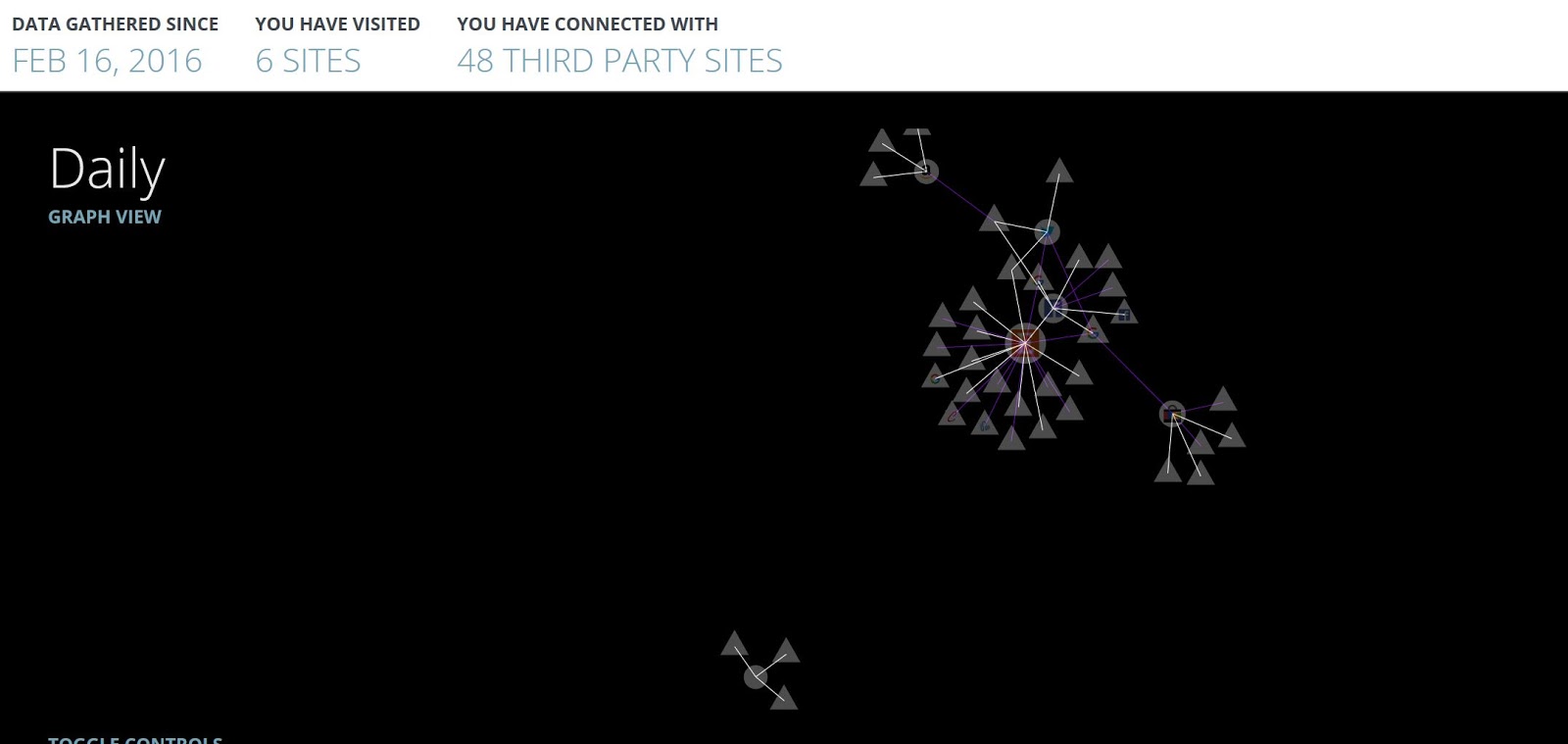
Pictured: REALLY?
In roughly two minutes, all I did was go to the aforementioned 5 sites, and I only logged in to facebook, Lightbeam recorded that 48 third party sites connected with me. What??? That's so completely insane. By clicked to two more pages, the number rose to 51. How is that even possible??
As was the case with Thimble, Mozilla's Lightbeam service proved to highly useful. This was another highly valuable activity for students of all ages, and I personally feel enlightened (and a little scared, to be honest). The internet truly is an amazing and terrifying tool, and I'm starting to understand why some people like the idea of going "off the grid." But is that even realistic anymore?

I have to say, I was skeptical when I first started clicking around this website, but I have been proven wrong. Mozilla offers some great tools for the expansion of knowledge, geared toward all students, and it's really cool that they're all free of charge. I can't wait to see how Laura utilizes it in class tomorrow!
