Tuesday, March 29, 2016

Where is the li(f)e?

What's your favorite filter?

Mine's Valencia, although Lo-Fi is gaining in popularity on my Instagram. Or maybe X-Pro II? So many choices, and I can control them all. Isn't that cool? I can dictate what my friends think my life is like by pressing a button. In a matter of lighting, my hastily-grabbed cup of coffee before work becomes a relaxing stop at the local cafe, and a quick literary caption paints the image of spending hours musing over the works of my favorite authors. In one tap, I've built an entire li(f)e for myself, and an outsider might never know the truth.

I have an image in my head when I read the title of Chapter 2 of Jill Walker Rettberg's Seeing Ourselves Through Technology that looks something like this:
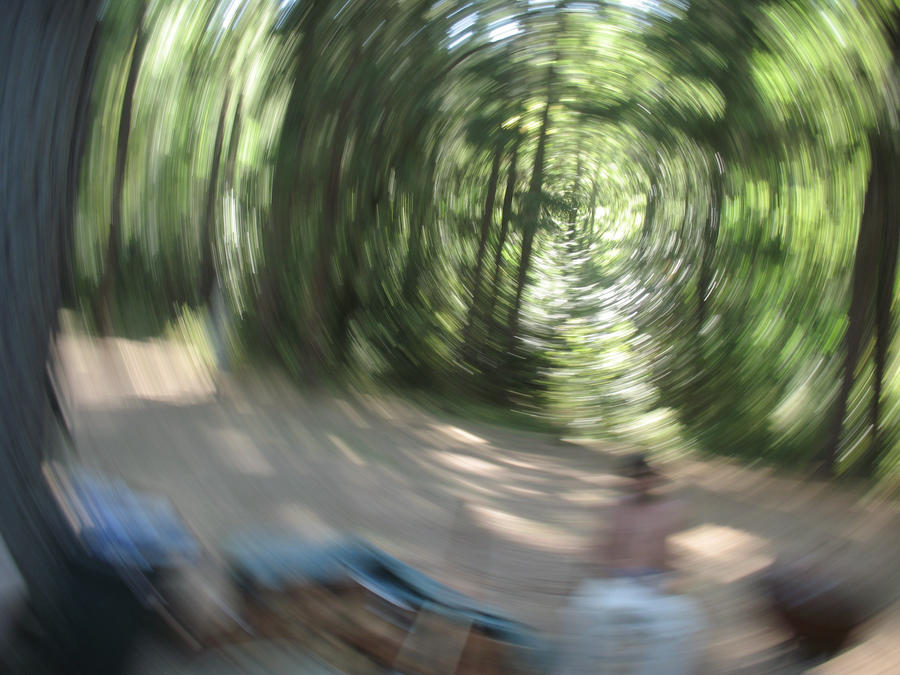
(Photo found here)

Filtered Reality. It's reality, but something is a little bit off about it. 

Rettberg raises a good point about filters-- they are generally used to remove what we don't want. On the most simplistic level, a coffee filter is used to keep the grainy, gross coffee grounds out of our morning (and afternoon and evening-- I don't discriminate) cups. Likewise, those handy Instagram filters lessen the features we'd like to hide. In popular culture, we don't just filter pictures, we filter our email, our social networks, and news sources. Filters have become so commonplace that in many instances we don't even realize that they are there. 

We live in a highly filtered culture. Most news cites offer a feed of "Top Stories," comprised of the stories that are popular at the time, the most shared, most read, most commented on. The rest of the stories on the site are still there, but the algorithms of the site push them lower down the list in favor of the stories that have more views. If we're only seeing what is popular, are we only learning the popular opinion? How is our awareness being swayed by only being shown the news that is popular?

Rettberg offers Reddit's up/downvote system as an example of a filtered system, and I can add Facebook, Twitter, and, most recently, Instagram, to the list. I have friends on Facebook who I never see and, due to this, I forget we are friends, because my likes and Internet tendencies have made it so the Facebook algorithms pushes them to the lowest priority. It's not even an active choice on my part, the social network does it all for me. Are our machines controlling us? Perhaps our dystopian worlds are not far off? (mostly kidding)

In the midst of Chapter 2, I found a particular paragraph that spoke to me-- I found it both interesting, and frightening. Rettberg says:
We cannot represent our lives or our bodies without using or adapting, resisting and pushing against filters that are already embedded in our culture, whether those filters are cultural or technological. Cultural filters change over time and are different in different cultures. We can and often do resist or change cultural filters, but most of the time we simply act according to the logic of the filter without even realizing that is what we are doing. (24-25)
The concept that we are so controlled is a scary one because it paints us as puppets, manipulated by "filters" well beyond our control. Going back to where I began, Rettberg comments that "One reason the filter fascinates us is that it gives the image that strangeness that defamiliarizes our lives. The filter makes it clear that the image is not entirely ours. The filtered image shows up ourselves, or our surroundings, with a machine's vision" (26). Following that thought, is my filtered cup of coffee trying to fool you into believing that my life is something other than it is? Or am I trying to fool myself. By looking at my life through the impartial camera lens, does it make it anything other than what it is?
Selfies can be raw and revealing. They can feel too authentic, too honest. Perhaps running them through a filter to boost the colours, overexpose the skin to hide its imperfections or give them a retro tinge is sometimes the only way we can bear to share these images of ourselves. (27)
This reminds me, almost unbearably so, of Frankenstein, when the monster says to Victor, "You are my creator, but I am your master." Are we too to be so controlled by the lives we create and dream into existence? What is this filtered lifestyle doing to our realities and our perceptions of the world? A recent article also comes to mind in light of this filtered, #instagood world-- Australian Instagrammer Essena O'Neill decided to walk away from the filtered life and, before leaving, edited the captions to many of her photos, explaining the emptiness and fake reality of the world that once consumed her. What does this say about the world in which we live?

On the flip side of all of these concerns, there is beauty to be found in the filters, and this thought occurred to me upon reading about #365grateful. Rettberg points out that an artful photograph of dirty laundry might remind us that there is a family to make that pile (okay, I know several people who would argue that they are perfectly grateful for their families and don't need the pile of laundry to remind them, but you see my point). This thought also led me to think about the past, and question if this world is so different from that of the past. After all, the Romantic poets certainly saw their worlds through a filter (if you follow my meaning). and we hail their work to this day. Is it so different? Aren't we also using our own filters for the purpose of making beautiful?

Chapter 2 ended with an interesting discussion on the racial implications of photography and the selfie. I had never considered the misrepresentation angle of photography in my view of filters and selfies but, especially when coupled with the discussion of photography and the African American community, I found that it raised an interesting case against the fears expressed in the rest of the article: "Taking selfies can be a way of avoiding cultural and technological filters that you don't like or that don't represent you in a way that feels real to you" (30).

Moving on to Chapter 3, Serial Selfies, I found that the abstract presented an interesting case for observing the full story, not just individual posts or pictures, but all of them combined, in order to attempt to understand the entire picture-- the entire person behind the profile.

I think about this a lot. A lot goes into the way one presents oneself on social media, and I often wonder what my profile looks like to those friends who don't know me all that well. Most of my posts are directed toward the people who I know look at my profile-- a moderately sized circle of friends and acquaintances-- but every so often I get a notification from someone who I barely know and I realize, they can see everything I post too. My friends know who I am, but what do I look like to those who don't know me?

Rettberg's study of the daily selfie is an interesting one, because it raises an interesting question of observation. Why do we like to watch the time pass via one snapshot a day? What are we hoping to learn about ourselves that a compilation of pictures might reveal? And further, how do people's responses reflect on the content we are putting out there?

I've seen some of these videos, but I decided to watch Rebecca Brown's video, mainly because her 6.5 year commitment impressed me, and made me think that she had a story to share. And wow, did she ever.


Beckie Brown's video is a poignant tribute to her life story, and it is a story that could not possibly be grasped in pieces. Just like life goes on, as do the photos, through the good and the bad. Brown used her story to raise awareness of her struggles, and further, to help people know they're not alone. Between the years of 14 and 21 are some of the most important developmental landmarks in a life. We see one snapshot from every day in her life through it all.

Pictures serve as representations of who we are, which is why Rettberg moves to her next topic, profile pictures on social networking sites, and ties this into self representation. Why do we choose the things we choose to represent ourselves? If the only thing a stranger could observe about my Facebook is a profile picture of my dog, or if a potential friend is looking to add me and sees a poodle, what must they think? And why would I choose that image as my social network "first impression"? These are all questions I have considered over my own social profiles, as well as in observing others.

When we are able to dictate for ourselves what is put out there, it is interesting to see what we choose. Regardless of filters or "the chosen selfie," there is a mindset which goes beyond. Getting to the root of why we do what we do has only become more complicated by the digital age and our new selfie culture. I look forward to further discussion of this in class!


Tuesday, March 22, 2016

White Flight and MySpace?

"White Flight in Networked Publics? How Race and Class Shaped American Teen Engagement with Myspace and Facebook"
danah boyd

The beginning of this article took me by surprise. I've openly admitted this before ,God only knows why, because I should probably be ashamed of my middle school self, but nevertheless, my entrance into the world of social media was widely influenced by MySpace. I was a huge fan of MySpace.com, and I never, not for a second, thought of it as being "ghetto." MySpace was the place where I and all my friends could set up our highly personalized profiles, upon which we would showcase our angle shots, poorly edited pictures, and unnecessarily emo music-- I don't know why 11 year old Marissa thought that My Chemical Romance "just got me" but oh man, she did.

So, for this reason, "ghetto" was a description I was surprised to hear coming from a kid who was the same age as I was at the time of the interview. Take into consideration, I've grown up in Elizabeth, NJ. The school I went to was by no means homogeneous in terms of race. The reason I moved on to Facebook my freshman year of high school, was because it was new and interesting. It was the next big thing.

boyd certainly put in the research to make a case for a more racially based view of things. I found what she had to say interesting, especially that digital environments are shaped by race and class in similar ways to physical spaces. I think this stands to reason, as ones digital life is typically spent with the same people they would spend time with in the real world. However, boyd also invokes the idea of "white flight," and draws parallels between the digital and the physical in order to show how "people's engagement with technology reveals social divisions and the persistence of racism" (4). This is where I jump ship on her argument. I think the concept of white flight certainly draws a provoking parallel, but it's going too far, and here's why:

People abandoned MySpace because it was no longer the new thing. People follow friends and fads and, on top of Facebook being the new kid on the block, MySpace was going downhill as a website. It didn't have a solid basis as a company, as it grew corporate issues arose and metastasized beyond control, it became too big and too bloated, along with several other death blows that are very well laid out in this article from The Guardian. MySpace was poorly handled and it fell out of favor because of that reason. People didn't drift away from it because of "white flight" to Facebook, they drifted away because Facebook had a future as a social networking site-- and this is coming from someone who, once again, would love to have her old MySpace profile back. MySpace was going downhill, and when Facebook became available to the public (aka anyone with an email address) in 2006, the site began to gain traction. Between 2009-2011, Facebook took off as the next big thing, and all others fell to the wayside.

That aside, boyd's research reveals that many different justifications were offered by the teens she interviewed, in order to explain their choice of one site over the other. Overwhelmingly, this had to do with preference in what the sites had to offer, usually based around where friend groups gravitated. It's an interesting thing to note that kids stay with kids who are like them or, as it's said, "birds of a feather flock together." This proves to be true in many realms and social circles, in school, and in life, it stands to reason that this would follow to the online sphere. boyd had the data to prove this, however, I don't think that noting this is admitting anything breakthrough. Of course people follow their friends, and they'll go to the site that is better suited to their needs and desires. The business failure of MySpace aside, if I had made my Facebook account in high school, and came to find that all the kids were on MySpace, I would have gone back to MySpace.

I think her article is well written and incredibly interesting, and it certainly made me consider racial implications. However, I don't think the case she makes holds water.

"Self- Segregation: Why It's So Hard for Whites to Understand Ferguson"
Robert P. Jones

This 2014 article takes us back to the shooting of Michael Brown in Ferguson, Missouri, a case which caused racial tension to boil and underlying instabilities to rise to the surface. It serves as an interesting juxtaposition to the racial conversation in the previous article, regarding the nature of races to group together. Sadly, the line between white and black seems to be becoming all the more bold every day, and is aggravated by more and more instances that seem to drive a wedge between the groups.
The area of New Jersey we live in is, luckily, very diverse. However this is not the case in many areas, as exemplified in this quote from the article:
"The social networks of whites are a remarkable 91 percent white. White American social networks are only one percent black, one percent Hispanic, one percent Asian or Pacific Islander, one percent mixed race, and one percent other race. In fact, fully three-quarters (75 percent) of whites have entirely white social networks without any minority presence. This level of social-network racial homogeneity among whites is significantly higher than among black Americans (65 percent) or Hispanic Americans (46 percent)."
It is important to expand beyond social circles to truly attempt to understand what the world is like beyond your proverbial front door. Every day there is a new news story that makes this case again and again. Much like the social circles of children, it would appear that adults don't tend to expand beyond the "birds of a feather" mindset. By acknowledging this mindset, we can attempt to work past it in all areas of life and see life through different eyes.


Tuesday, March 1, 2016

But first, let me take a #SELFIE

Fair warning, I'm going to have too much fun with this section.
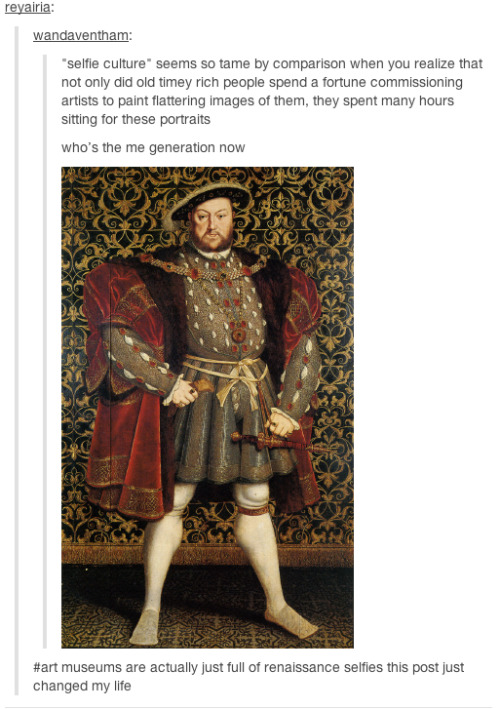
To begin, the original "god" of selfies,


And to continue on through history:


But to get to the important point of this post, selfies. Love them or hate them, they're here, and they're a part of culture. I found these blogs on selfie culture to open up an interesting discussion on society's apparent obsession with...taking pictures of ourselves?

Full disclosure, I'm vain enough to love taking selfies. When I was in middle school, the "Myspace angle" was the thing to master and oh man, did I master it (and oh man did I ever delete all those pictures 5 years later, when I realized how stupid they were).  Selfies are interesting, because yeah, they're vain. They're pure vanity, and they're also an odd form of idealism, i.e.:

Above: Something I really am mildly upset about.

All joking aside, our culture is big on how one presents oneself. Because we're in control of what we're putting out there, we portray life on our terms-- i.e. I know exactly what lighting I look best in to take a selfie, and that's going to be my profile picture. And that's also not going to be exactly what you see when you see me IRL (in real life). The selfie presents an interesting form of idealism which, I think, has the potential to be dangerous because, whereas I had several years of living with myself and becoming grounded as a person, there are a lot of kids out there who are growing up surrounded by perfect looking selfies and the #instagood life which, sadly, are far from reality.

The first point that I want to note from the blogs is from Part I: The Digital Humanities and Selfie Culture. Losh cites Posner's idea of "the creepy treehouse," which is the way Posner and her students seemed to describe the social networking community, "where the authority figure wanders into a realm where students feel entitled to privacy." Being "entitled to privacy" is an interesting concept to me, and I question, is it real on the internet? Sure, you're entitled to privacy, but having a Facebook page connecting with 500 of your "closest friends" is not close to the same as being in your private clubhouse with your two besties. The idea of privacy is certainly changing, as is the definition of friendship.


Although a lot of topics were covered in the blogs, I'm stuck on the idea of selfie and self image, and how that is affecting people in our culture. Part 3: Networked Spaces, Slut Shaming and Putting Selfies in Dialogue with Theory brought up the case of Amanda Todd, the 15 year old girl who committed suicide, as a result of bullying, which began when it came out that there were nude photos of her online. She was in 7th grade. She was a child.

Kids are always going to make bad choices, get in trouble, and be made fun of. To pretend otherwise is to be ignorant of the human nature, but this one of the landmark events in the history of bullying, because it took place in our new online world. Amanda Todd is an example of a worst case scenario and, heartbreakingly, she is now one of many. She was a struggling child, she made a bad choice, and she was taken advantage of, but the magnitude of the tools she used led to the ramifications being far greater than she could have ever controlled. This is the dark side to our selfie culture. On its face it is harmless, stupid, and vain but, as with all things, there are deeper implications. With great power (or, perhaps, great audience or great tools) comes great responsibility. This brings me back, once again, to the question of kids who have grown up only knowing the online world. Parents must decide where the boundaries are because, quite evidently, the repercussions of online actions can be a lot more lasting.

Moving on, I found myself going down the rabbit trial of the "Familiar Stranger" theory of Stanley Milgram. Before I read further into the definition of the term I could immediately guess how this would connect to the online world, because it sounds like something I believe many of us can understand. Milgram, a social psychologist, identified this theory in the early '70s in regard to urban anonymity. The theory is quite simple, that people recognize one another through regular mutual activities, but do not interact. Taking to the digital realm, this could be likened to that one kid you met in high school and friended for the heck of it, and you haven't spoken since. Sometimes you like their Facebook status, and you don't necessarily want to unfriend them because you feel like you have a connection but, in reality, you've never had a real conversation.

Part 4: Diversity, NetProv and Service Learning made, in my opinion, one of the best points in the series. Losh cites Marino as speaking on the importance of "look[ing] at the history of self-representation, not just portraiture but semiotic self-representation of all kinds that was fundamental to human culture. This could include writing, such as autobiography, letter writing, and journaling." He expounds upon this by detailing the assignments he gave to his #SelfieClass at USC.
I think that Marino's assignment to his students was inspired and made the selfie into something so much more. His assignment was a study of introspection which went far beyond taking a good picture. I particularly liked Know Thy Selfie: An Exercise in Selfie Revelation. The proposed analysis of elements in each selfie is supposed to allow for self reflection, and it's something I would like to try. Upon identifying key elements between the pictures, the students then had to write a thesis analyzing what they saw in themselves. For similar reasons, I also found Why do my Facebook Friends look just like me? to be a cool idea for a class assignment. I think that these kinds of activities would be great to bring into a writing classroom, because they offer a way of keeping students relevant and interested, and not just working toward a grade by doing assignments they don't care about.

I think it is great that so many of these courses are shared online freely, and it's certainly appropriate, considering that the subject matter is our current digital age. One of the biggest benefits of the internet is the opportunity for collaboration and communication, and for building communities, and it's nice that all teachers are able to share and access material across the community.


It's haunting me.

Tuesday, February 23, 2016

"The whole is greater than the sum of its parts"- Final Net Smart blog

To simplify what I felt as I came to the end of Net Smart, guys, the Internet is really cool. I don't know if we appreciate that fact enough nowadays, and reading this book has helped me to rediscover some of that wonder that I have been taking for granted.

Chapter 5: Social has a Shape
I have always been interested in the concept of "Six Degrees of Separation," aka the theory that everyone on earth is only six connections away from everyone else. The scariest thing about this concept is that a) it is widely accepted as fact, and b) with the help of social media, it's almost inevitable. Tying into that, one the of the most incredible things that I read in chapter 5 was that people I do not personally know could have a statistical influence on my life. Rheingold cites facts that reveal that "friends of friends have about one-third as much influence as people you know directly. The surprising implication is that at least part of your happiness might depend on people you never met"  (198). Rheingold stipulates that this is based on fairly recent research, and so it is only "tentatively" true, but the researchers do make a good case for it to be a viable hypothesis. Frightening as this was to read, I can see it being true. After all, it is not uncommon to lust after the beautiful, photogenic lives that are portrayed both by friends, and by those we don't know. However, it's pretty scary to hear that something as big as overall happiness can be swayed by people we may never meet in real life.

Later in the chapter, I attempted to do as Rheingold suggested and I googled "Visualize Facebook social network," but I learned something interesting. This may have once been a lot easier, but Facebook has cracked down. I found a 2009 Mashable.com article that offered several different apps that allowed people to visualize their Facebook network and I was excited to try them out, only to find that the majority of them have been shut down. After some more research, I learned that the Facebook API (Application Programming Interface) is no longer making it easy to access such information-- personally, I would guess that this is due to privacy issues, but I was unable to find a concise answer. I found some external apps that seemed to find ways around this rule but, as I'm not interested in viruses, I decided against testing them out. Regardless, that's an interesting development since the book has been published!


Pictured above: The only working link from the Mashable article. I thought this was a pretty interesting representation of Facebook users but note-- this is from 2008. Imagine how many more lights there would be now! Also, the quality is pretty laughable, considering what Facebook has grown into in the past 8 years.

My rabbit trail aside, the concept of Social Network Analysis (SNA) is fascinating. I'm sure many of us have had the experience of finding a mutual friend with just about the last person you'd expect. What a small world we live in. SNA has also provided the interesting information that our concept of "the ties that bind" is shifting. Although people still widely prefer and turn to friends with whom they have established strong ties, the weak ties are also valuable. Rheingold cites Granovetter who noted that the weak ties are the ones that "can be important in seeking new information or stimulating innovation"  (206). I can attest to that in a way: Recently I bought clothing from the online store of a girl who I met my freshman year of college, with whom I had maintained only the slighest Facebook friendship with. However, a bond was formed! That would never have happened fifteen years ago. Also, in regard to the concept of "being a bridge" via social media, just today I found out about an apartment for rent through a friend of a friend. I would consider the girl I am friends with on Facebook to be "weak bond" amongst my friends, as we don't know each other too well. However, although we aren't personal friends, I would trust her opinion. If I were apartment-hunting, I would certainly have followed up with the advertisement. She acted as a bridge!

I have responded to this sort of thing in previous blogs, but I will say it again, I appreciate what Rheingold has to say about the merit of social capital, and the idea of "paying it forward." In this instance, he mentioned his relationship with a man called "Philcat," who he met in a chatroom online years ago, but who resurfaced in his life to help him out when he battled cancer. Although the online world can be troublesome, this is a great example of the good that can come from online interaction, not just between people you know in real life, but with people you don't. Of course, a degree of discretion is crucial, but a great deal of good can come from being a conscientious contributor to the online world.

I found Rheingold's concluding discussion of Facebook to be timely, because it touched upon concerns that I am having at this exact point in my life. I made my account in 2007, when I was entering high school. While it is fun for my high school friends and I to look back on so many years ago, it is also a little awkward to know that everyone can see those pictures. Because there is so much of it, it is hard to know what to pick and choose to hide. What I consider memories of my childhood are out there for every one of my connections to see. It's certainly something to consider.

Chapter 6: How (Using) the Web (Mindfully) Can Make You Smarter*

*Excellent use of parentheses.

The public sphere is certainly something to face with care and consideration, especially now that so much can be thrown out into the ether and revived at any point. As was the case throughout the book, Rheingold approaches this fact with reflection, and gives some validity to the cons, as well praising the pros. It's scary that we are living in such a new age, where everyone is struggling to know how to handle the new media we are faced with. How can we dub things legal or illegal if the law has never faced such developments in the past? And who are most equipped to make these decisions? The generation who grew up with the technology? Or the older generation who knew a world before it?
Additionally, a problem that I know I will one day have to face is, how is a parent to advise their children to navigate this new world? New media has gone a lot further than it was when I was growing up. I thought that what boyd had to say on the matter was poignant, "Create a dialogue...Just because [challenges] are complicated in new ways that are baked into [your children's] lives doesn't mean that they are so radically different" (246).

I am very happy to have experienced this book, and to have gotten the opportunity to Skype with Howard Rheingold. I was skeptical at first, because I didn't know the perspective or tone that he was going to take in the book, but I am pleased with the results. As he concludes, it is up to us to make the effort with the tools we have been given, and he has certainly given me quite a bit to think about.

-------

To conclude this post, I have thought about what I want to take from this class, and have decided that I want to use the tools that I have learned about in order to create something really interesting with code. Mozilla's activities made an impact, and I would love to explore the site further. I know it might be a large undertaking, but I am very interested in code, and would love to use that toward the final project. I think that the programming languages are incredibly interesting, and I have always wanted to learn more about the different kinds that are out there-- right now I only have the most vague knowledge of HTML, C++, and Java. I want to learn more.

Tuesday, February 16, 2016

Big Brother is Watching You (thanks, Mozilla)

In college, I minored in Business, focusing mainly on Marketing and Advertising. I mention this fact for the reason that my brain has been trained to be attentive and interested in the associations made between product and perception. For example, when I think swoosh, I think Nike, I think Just Do It.
How does this tie in to today's blog? Because, I must admit, when I heard the name "Mozilla" tied to the website, I immediately linked the the web browser, and had no idea that the organization went beyond that. Unlike Google, which I know as a company outside of Google.com, I was unfamiliar with Mozilla. So, before I explored the subject matter for today's blog, I did some research on the Mozilla Corporation in order to refresh my perception of the Mozilla name. On the company's website I found a list of 10 Principles which they aim to uphold. These reminded me of things we've discussed in class. They are, as follows,
1. The Internet is an integral part of modern life—a key component in education, communication, collaboration, business, entertainment and society as a whole.
2. The Internet is a global public resource that must remain open and accessible.
3. The internet must enrich the lives of individual human beings.
4. Individuals' security and privacy on the Internet are fundamental and must not be treated as optional.
5. Individuals must have the ability t shape the Internet and their own experiences on it.
6. The effectiveness of the Internet as a public resource depends upon interoperability (protocols, data formats, content), innovation and decentralized participation worldwide.
7. Free and open source software promotes the development of the Internet as a public resource.
8. Transparent community-based processes promotes participation, accountability and trust.
9. Commercial involvement in the development of the Internet brings many benefits; a balance between commercial profit and public benefit is critical.
10. Magnifying the public benefit aspects of the Internet is an important goal, worthy of time, attention and commitment.

Although this is aside from the post of this blog, it was important for me to read the values of Mozilla as a company, prior to knowing what they have to say about web literacy. Now, they have established credibility. 

Going on to the content of Teach.Mozilla.org, I first went to the Web Literacy tab on the Teaching Activities Page and found it to be divided into three categories, "Explore: Reading the Web," "Build: Writing the Web," and "Connect: Participating on the Web." These three categories broke into subcategories, which were point by point definitions of terminologies commonly see around the web, but perhaps unfamiliar to some. It is a good feature to have on the site as a point of reference, especially if the site were to be utilized by a teacher.

The first headline that interested me was the "Back to School Write the Web Kit." I've always been interested in coding, but never learned any beyond basic HTML. Within this headline were 5 activities, and I chose to try "3 Things I <3 Teaching Kit," to "Understand Web Navigation." I really liked that the instructions were highly comprehensive, and included time allocations and helpful tips along the way. In this way, it certainly seemed to be aimed at teachers of younger students, which does not apply to me personally, but nonetheless the formatting was helpful. However, the most exciting thing I picked up from this tutorial, and what I mainly want to focus on, is the Mozilla Thimble Web Maker. Guys. This thing is so cool. At first I was unsure because it was Mozilla advertising one of their own products, but it didn't disappoint. On the contrary, I so enjoyed my time playing around on this website. The activity wound up introducing me to so much more, and I'm genuinely excited to play around on this more in the future. Definitely not just for kids! And, going back to what I opened with, I thought the Thimble tool was a very cool manifestation of Mozilla's 10 Principles. Mozilla built the tool, but chose to provide it free of charge as a helpful learning tool to the public.

The second headline I chose to explore was the "Protect Your Data" headline, under which I found 6 activities. I chose the "Cookies and Third-Party Tracking" activity, mainly because I saw that it utilized another Mozilla open source tool called Lightbeam. I had great luck with Thimble, so I was hopeful. Cookies are one of those things that I vaguely understand, but a vague understanding is not good enough when it comes to issues of online security.
The first link I clicked on brought me to the site of a web series called Do Not Track, specifically Season 1 Episode 2, "Breaking Ad." This episode taught me what cookies were, basically they collect information that helps tailor a website to me personally, my username and preferences, among other things. One of the weirdest things I learned from this video is that legally, at least in Great Britain, users are required to be told that cookies are enabled on a webpage (this is not legally required in America), but there is no "Reject" button. You can only say "Ok," as in, "I acknowledge that this is happening, here's my info." That's a little Big Brother-esque, don't you think? Additionally, I learned about Ethan Zuckerman, the man who unintentionally created the first targeted pop-up ad. So, if anyone would like to create an angry mob, I'm interested in starting one and finding him ;)
The video proved to be very interesting, especially in regard to my advertising background, and it was pretty crazy to see how advertising, cookies, third parties, and my personal information all come together. Absolutely nothing is personal or sacred! You, as a person, are literally watched, collected, and sold for advertising purposes.
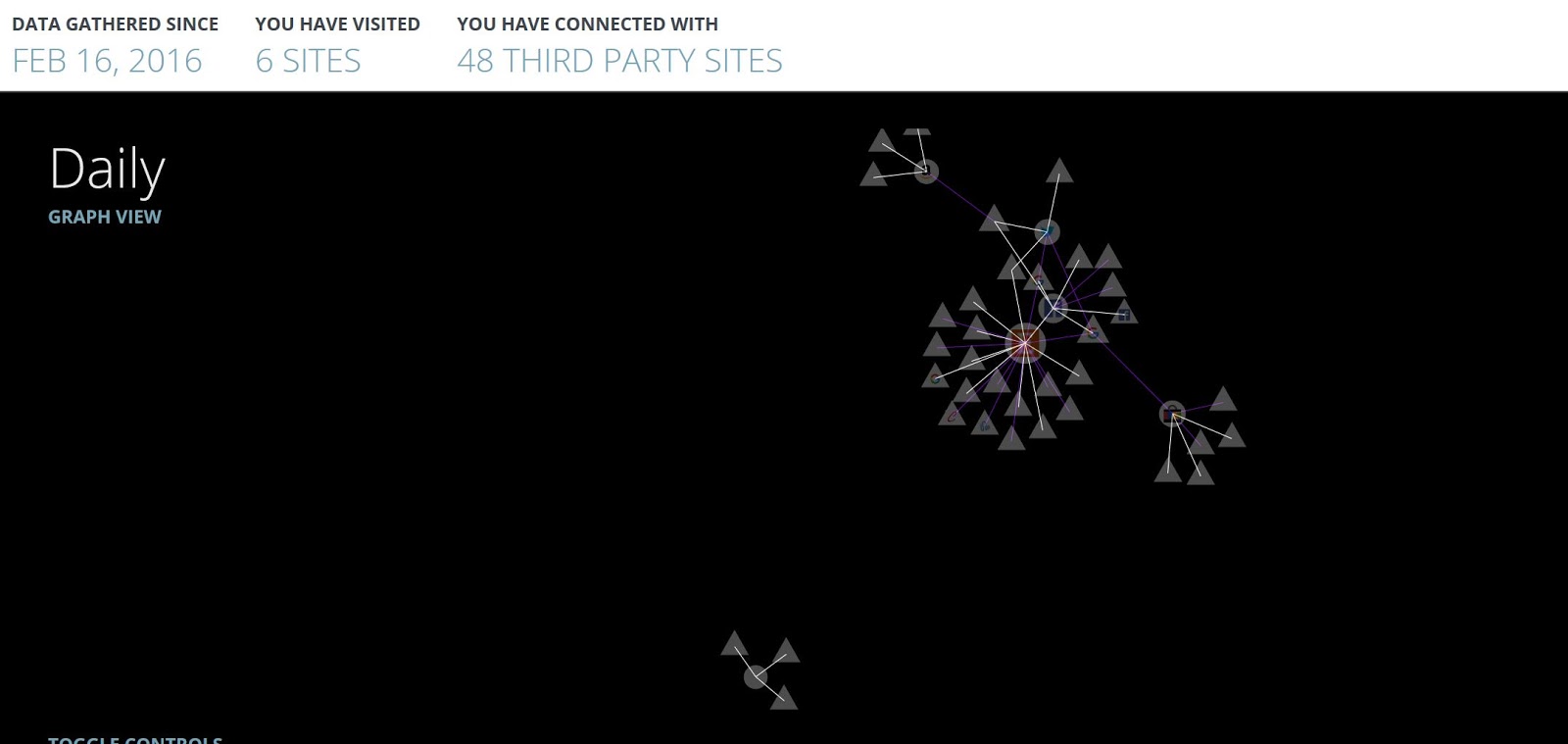
Going back to the activity, Lightbeam did not disappoint. I enabled the add-on to Firefox and did as I was told, I browsed. I chose my 5 favorite sites, Facebook, Twitter, Etsy, Ebay, and Amazon.

Pictured: REALLY?

In roughly two minutes, all I did was go to the aforementioned 5 sites, and I only logged in to facebook, Lightbeam recorded that 48 third party sites connected with me. What??? That's so completely insane. By clicked to two more pages, the number rose to 51. How is that even possible??

As was the case with Thimble, Mozilla's Lightbeam service proved to highly useful. This was another highly valuable activity for students of all ages, and I personally feel enlightened (and a little scared, to be honest). The internet truly is an amazing and terrifying tool, and I'm starting to understand why some people like the idea of going "off the grid." But is that even realistic anymore?


I have to say, I was skeptical when I first started clicking around this website, but I have been proven wrong. Mozilla offers some great  tools for the expansion of knowledge, geared toward all students, and it's really cool that they're all free of charge. I can't wait to see how Laura utilizes it in class tomorrow!


Tuesday, February 9, 2016

A Whole New World! Response to Net Smart Chapter 4

"If you've never read any business case histories, but if you've run a guild, or organized a raid, or spent time resolving drama and disputes in World of Warcraft, your mind-set is well prepared for the real world in a very different way than a college MBA would be prepared to run a company."

This quote that Rheingold cites from Joi Ito in Chapter 4 of Net Smart is a telling representation of our 21st century Digital Age. We live in a changed world, and it is fascinating to me that the technologies that were once seen as merely being fun are now beginning to have a different perception in mainstream society. This isn't to say that just anyone should go out and list World of Warcraft in the "Relevant Experience" field of his or her resume, but it's an interesting concept. It's nice to see that there are acknowledged benefits to "nerd culture."

There are two things that I continually appreciate about Rheingold. Firstly, as I have mentioned before, he refuses to make the digital world into a bogeyman, and he achieves this by continually linking present advancements to those of the past. For example, he says that "Social media are part of a lineage that connects cave paintings to alphabets to hyperlinks." I think that this is a brilliant comparison, and I think that if anything could sooth the worries of those who aren't prepared for digital advancements, this might solve the problem. I quoted that on my Twitter for a reason, it really made me think!
The second thing that I appreciate about Rheingold's study of the online world, is that he has fully immersed himself in it. When I am reading this book, I don't sense the words of a lofty academic reflecting on the pleasures of the "youths." Rheingold explains his own experience in virtual communities, and defends them as real places in which one can find friendship and community. This is a beautiful asset of the online world, and it is nice to see it noticed and appreciated for what it is.

His discussion of the differences between the concepts of social "networks" and social "communities" was also interesting to me. It's not something I ever considered, but it is certainly true that there is a difference between the etiquette that is required for participation in each. There may be a huge difference, for example, in the network of classmates and coworkers that one forms on his Facebook, and the fandom community that he is a part of on Tumblr. There are different rules governing different online interactions, just as there are for the face-to-face interactions of daily life. Rheingold offers several helpful tips throughout this chapter, but his tips for behavior in online communities really struck me as being important for two reasons. First, many people turn to virtual communities, and it is good to know basic etiquette. Second, it may not be obvious when it's done right, but it is excruciatingly obvious when it is done wrong.


Pictured: Facebook done wrong.

Access to the internet brings people together and enables them to stand together for causes that they believe in. The discussion on crowdsourcing brought to mind websites such as GoFundMe, Kickstarter  and Indiegogo, to name just a few. These sites have enabled dreams to become realities for so many people through the donations of supporters who are interested in the ideas of their peers. I especially liked Rheingold's classification of crowdsourcing as "playbor orgaized by and for the playborers' benefit." Wikipedia is my personal favorite example of crowdsourcing and collaboration that he discusses, because it was, for so long, such a bad word in society. If most teachers I had growing up were to define Wikipedia it would probably be as follows: "Wikipedia: n. The literal devil that leads students to sin." On the contrary, instead of collaboration leading to mass chaos, the majority of people who edit Wikipedia pages are educated, knowledgeable, and quickly fix any mistakes or pranks that may appear. While Wikipedia, like all sources, must be verified, it is an incredible example of what happens when people join together to contribute. While the system is, as Rheingold says, vulnerable to the world, the world is also what makes it invulnerable. What a cool notion!

Tuesday, February 2, 2016

Rosenberg and Postman's Articles


In the Context of Web Context:


I found that this article offered helpful tips on how to navigate the web. Something that I have found to be more and more of a problem in my post-graduate life is stepping into the world outside the college bubble and facing the onslaught of both news and "news." Differentiating between good and bad sources is crucial-- as an example, just today I was researching the Zika disease that has become so prevalent. I noted that along with major news sites, there was an article about it on Buzzfeed. Nothing against the writer, but when I think "reliable," Buzzfeed isn't the first website to come to mind.
Learning how to sort through all the junk is a crucial skill, and I especially will remember "whois." I believe Rheingold mentioned that resource as well, and I have already bookmarked it for future use.
Rosenberg also mentioned other internet checks and balances that I had never thought of, such as looking up the site in Internet Archive, and looking into the source code. These are just further tools that will be helpful additions to my skill arsenal.


How's Your Bullshit Detector?


Hmmm. As for this article.
Although I can certainly relate to the frustration expressed by Stephen Pizzo, I felt that it wasn't a very worthy introduction to the piece that followed. It was extremely opinionated and rather scattered. In fact, I was fairly confused at first as to what I was reading, before I recognized it as a lead-in to the main point, Postman's address.
On that note, I'll turn to Postman. I found myself agreeing wholeheartedly with the first few paragraphs of his address. I believe that Hemingway would be proud of the way in which his famous phrase has been expounded upon, because crap detection is an important skill to have. Bullshit wastes everyone's time and, looking at this from the perspective of a future professor, I don't want to waste my students' time, or my own.
I was totally on board with the points Postman made about pomposity and inanity- my favorite part of the article was as follows,

"The press and air waves are filled with the featured and prime-time statements from people who are in no position to render informed judgments on what they are talking about and yet render them with elan and, above all, sincerity. Inanity, then, is ignorance presented in the cloak of sincerity."

I couldn't agree more, this is extremely frustrating to me and I was glad to hear it said so eloquently.

However, I started losing Postman's train of thought as he started talking about "Eichmannism," and had to do some research on the side to understand that reference, which distracted me from the point of the article. When he went on to superstition, he lost me completely. I felt that his points went from objective to opinionated. At first the address was factual and engaging, but when he introduced superstition, it got rather meta and he lost me.
Further, I have to pose the question-- is it the job of the teacher to educate the youth along such subjective lines? Perhaps it is the job of the teacher to instruct against writing bullshit that purposely wastes the time of everyone involved, but I would ague that it is not the job of the teacher to educate subjective thought.

I look forward to discussing this article further in class.